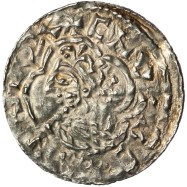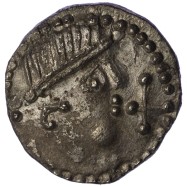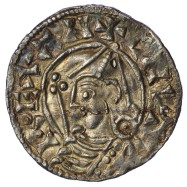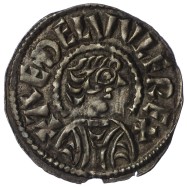


Viking coinage of York
Cnut
Patriarchal cross
Cunnetti
Type IIe - C1(b)/CR-G
1.35g 19.8mm
Spink - 993
North - 501
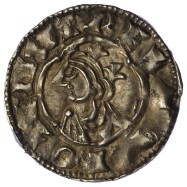
Obverse:
CVN NET TI. Small cross in centre, pellets at two of the four angles. Groups of pellets and crosses as stops.
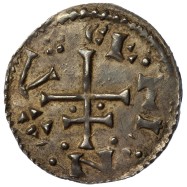
Reverse:
CNVT at limbs of patriarchal cross, RIX between, pellets in field.
Good very fine and toned.
Ex Drewry Collection
Likely Ex Cuerdale Hoard
Apart from a handful of coins discovered in 1611 at Harkirke, Lancashire and some isolated single finds across Europe, it is conservatively estimated that at least 99% of surviving examples of this type were part of the Cuerdale Hoard.
The Cuerdale Hoard was discovered by a group of workmen repairing the embankment on the south side of the banks of the River Ribble, near Preston, Lancashire on 15th May 1840. It consisted of nearly 7,000 coins and nearly 1,000 ounces of silver. It is the largest hoard of Viking coins ever found in the British Isles. A number of the coins were dispersed soon after the find but the majority of the hoard was seized for the Crown, Queen Victoria in right of her Duchy of Lancaster; the Duchy then passed it to the British Museum for examination prior to its distribution to over 170 recipients, including institutions and private individuals. The suggested deposition date is between 903–905 AD.
For further reading see:
Lyon, S. & Stewart, I. (1961), 'The Northumbrian Viking Coins in the Cuerdale Hoard' in 'Anglo-Saxon Coins: Studies Presented to F.M. Stenton on the Occasion of His 80th Birthday'. Methuen & Co Ltd. pp 96-121.
Hawkins, E. (1843). 'An Account of Coins and Treasure found in Cuerdale'. The Numismatic Chronicle and Journal of the Numismatic Society, 5, pp 1–104.
Data sheet
Specific References
Viking coinage of York
Cnut
Patriarchal cross
Cunnetti
Type IIe - C1(b)/CR-G
1.35g 19.8mm
Spink - 993
North - 501
©2013-2026 Hammered British Coins Ltd. All rights reserved.