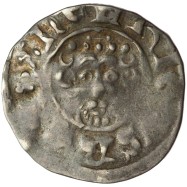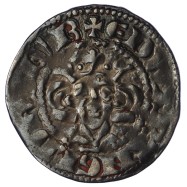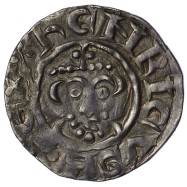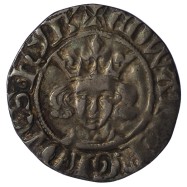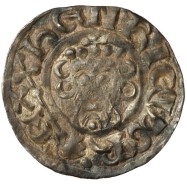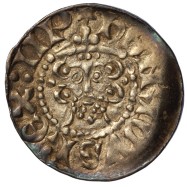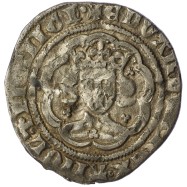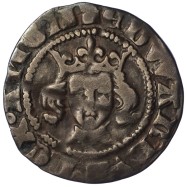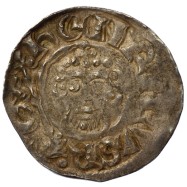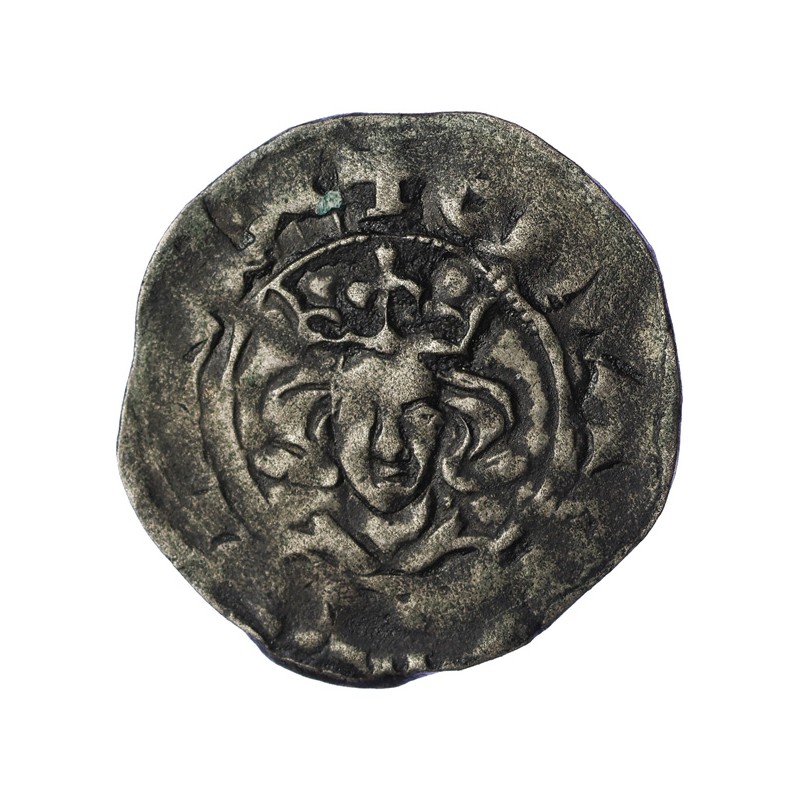


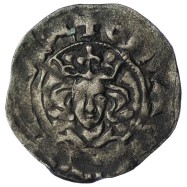
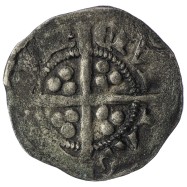
Edward II/III Base Silver Halfpenny Imitation
'Hull Dock' Coinage
CIVITAS LONDON
0.51g 14.6mm
Spink -
North -
Mayhew - 288
Obverse:
EDWA[RDENSIS R]EX. Crude facing crowned bust.
Reverse:
CIVITAS [LONDO]N. Longcross with three pellets in each angle.
About very fine, toned, scarce and historically interesting.
Ex CNG eAuction 574, 6 November 2024 - Lot 870
Almost certainly from the Albert Dock Hoard, Hull 1868.
The Albert Dock (Hull Dock) Hoard, was discovered in September 1868. According to the contemporary account of Alderman John Symons, the discovery was made by the navvies working on the dock, who reported that “some hundreds” of small coins had come out of the earth. “As soon as the coins fell out there followed a general scramble for them”, the finders divided the coins amongst themselves, with many subsequently disappearing into private hands. Nineteen examples were recorded in the Hull Museum catalogue in 1927.
Seventeen examples were rediscovered amongst unsorted material salvaged after the bombing and subsequent flooding of the Albion Street Museum during the Second World War. Further examples had already entered the British Museum and private collections, allowing the group to be studied in some detail.
The coins are debased sterling imitations of the Edwardian coinage, all struck from the same distinctive obverse die reading +EDWARDENSIS REX. The lettering is noted as being large for halfpence and the crown identifiable with only three, instead of five, projections. Two reverse dies are known, one reading CIVITAS LONDON and one reading MONETA MARCES. The latter led to their traditional attribution to the coinage of John the Blind of Luxembourg, although their precise place of manufacture remains uncertain. Metcalf suggested the possibility that these could be the result of a local Hull forger, while Mayhew attributes these to Marche-en-Farmenne, Luxembourg. Banks remained neutral between English and Continental manufacture.
As noted by Mayhew, without the Marche signed pieces being present, the assumption would have been that these were locally produced, not far from the findspot. Banks did consider the possibility that the coins were in transit when they were deposited. If locally produced imitations, they might have been destined for London for wider distribution, although their obviously debased and imitative character might have made this problematic. Banks emphasised that there was no reason to assume that the movement was necessarily one way. The commercial traffic through Hull could potentially have carried the coins either into England or back towards the Continent, leaving their precise origin and intended destination unresolved.
Six coins from the hoard were included in the F. “Monty” Banks Collection, sold by Glendining’s on 9 March 1977. Five read CIVITAS LONDON, while the sixth read MONETA MARCES.
See:
Metcalf, D. M., (1964) ‘A Fourteenth-Century Deposit from Hull’, British Numismatic Journal, Volume 33, p. 80-82.
Banks, F., (1968) “The 1868 Hoard from the Albert Dock Lock Pit, Hull,” British Numismatic Journal, Volume 37, p. 65-72.
Data sheet
Specific References
Edward II/III Base Silver Halfpenny Imitation
'Hull Dock' Coinage
CIVITAS LONDON
0.51g 14.6mm
Spink -
North -
Mayhew - 288
©2013-2026 Hammered British Coins Ltd. All rights reserved.