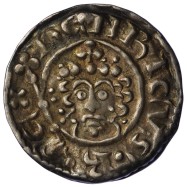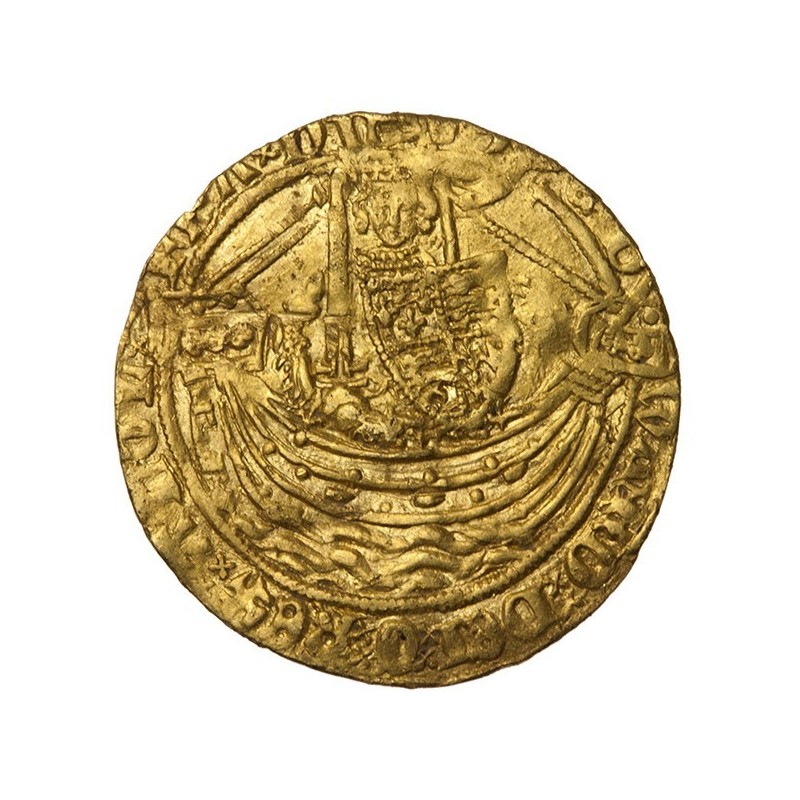



Edward III Gold Half Noble
Post-Treaty
London
Unique
3.81g 24.7mm
Spink - Not listed
North - Not listed
Obverse:
EDWARD DEI G REX ANGL FRA DNS. King standing facing in a ship, sword in right hand, shield in left. French title, Treaty X.
Reverse:
DOMINE NE IN FVRORE TVO ARGVAS ME. Florated cross with lis terminals, lions between with crowns above, upturned E in centre, all within tressure of eight arches. Unbarred A’s.
This is a unique as a true London post-Treaty half noble. Although showing the normal signs of a detecting find, it is still about very fine with all the details present.
The existence of a true London post-Treaty half noble has long been a tantalising possibility within the Edward III series. L. A. Lawrence, writing in 1933, stated: “The London half-noble as a true coin is unknown, and only one mule, which has a Treaty obverse, represents the London coinage.”
Potter similarly noted that the only known London half noble of the post-Treaty period was struck from a ‘Treaty B’ obverse, paired with a new-style reverse bearing an E and pellet in the centre. He observed that, although no London half noble obverse bearing the French title appeared to have survived, evidence that such dies were manufactured was provided by two dies subsequently altered and overstamped RIC and used after Edward III's death.
Stewartby, in 2009, further recorded: “Nearly all of the gold of the Post-Treaty period was struck into nobles. Half-nobles are extremely rare [Calais]…. The only London half noble of this period is a mule, from a Treaty B2 obverse die, with annulet before Edward, and a reverse with Post-Treaty lettering….” Stewartby also recognised that the existence of Edward III obverse dies, subsequently altered from EDW to RIC, demonstrated that post-Treaty half noble dies had indeed been prepared, even if their use during Edward III's reign had remained uncertain.
One of the interesting features of the coin is the form of the X in REX on the obverse. Rather than the usual curule X found on the other known half nobles, the present coin employs a Treaty style X. The curule X is familiar from Treaty-period silver groats and halfgroats, but its use on gold is very rare. Equally significant is the shortened French title FRA, rather than the FRANC found on the known Calais post-Treaty half nobles and on the Richard II pieces struck from the altered Edward III dies.
The present coin is of exceptional numismatic importance, a true post-Treaty London half noble but not from the altered dies previously envisaged. It now fills the gap in the sequence of the post-Treaty coinage.
Lawrence, L. A. (1933), “The Coinage of Edward III from 1351. Part IV.” The Numismatic Chronicle and Journal of the Royal Numismatic Society, Fifth Series, Vol. XIII, pp. 15–79.
Potter, W. J. W. (1964), “The Gold Coinages of Edward III: Part II. (A) The Treaty Period (1361–9).” The Numismatic Chronicle and Journal of the Royal Numismatic Society, Seventh Series, Vol. 4, pp. 305–318.
Stewartby, Lord. (2009) English Coins 1180–1551. London: Spink, pp. 231–232.
Data sheet
Specific References
Edward III Gold Half Noble
Post-Treaty
London
Unique
3.81g 24.7mm
Spink - Not listed
North - Not listed
©2013-2026 Hammered British Coins Ltd. All rights reserved.